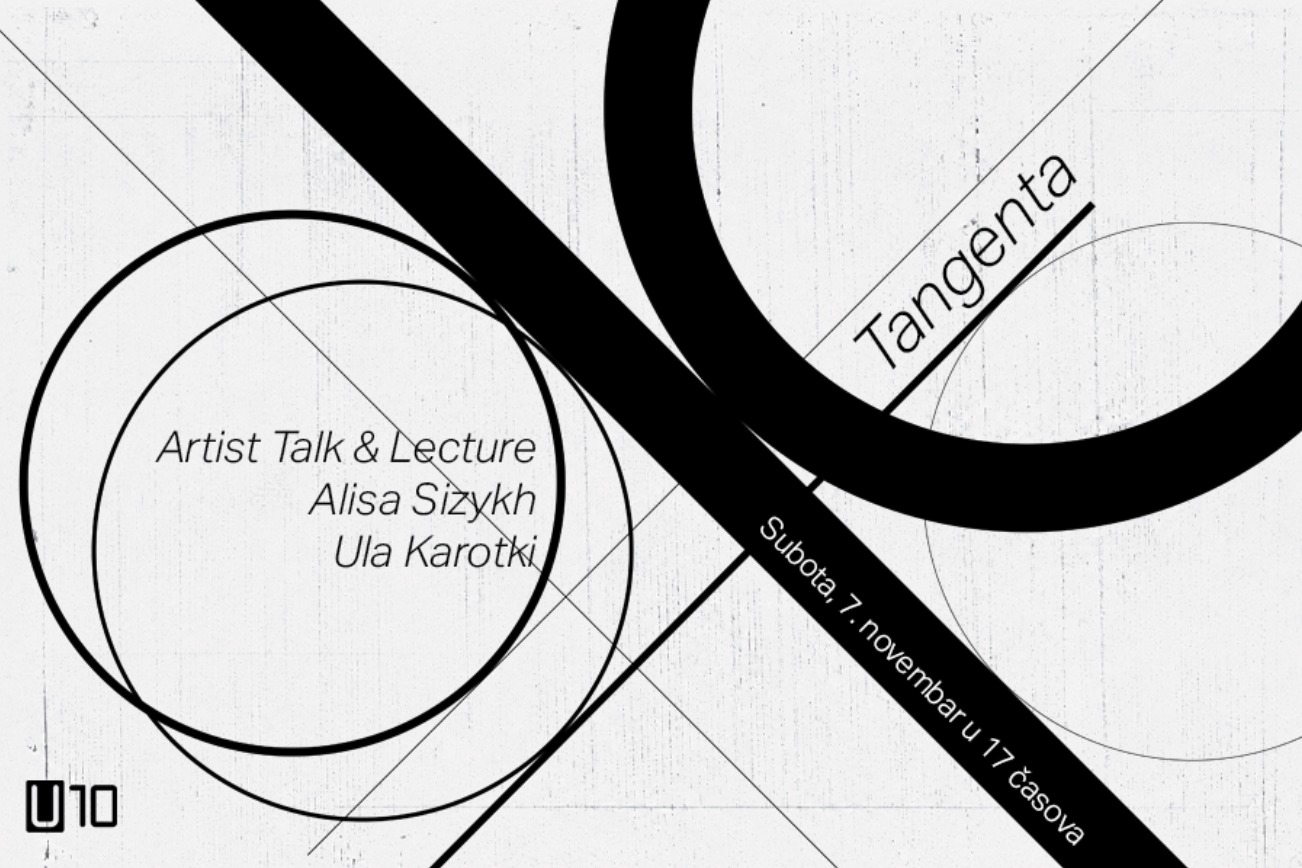
Finissage program of the exhibition “Tangenta”
Artist talk with Alisa Sizykh and lecture by Ula Karotki
Saturday, 7 November, 5 pm
Information about Alisa’s artist talk:
Starting from the installation Letters on Peace, Alisa Sizykh reflects on dialogue as an artistic method and a minimal form of resistance to political disengagement. The work transforms private email correspondence surrounding a failed exhibition about “peace” into a public archive of conflict between a curator and nine artists. The talk asks whether dialogue remains possible when the same words carry radically different political meanings, and when calls for “peace” can be used to obscure responsibility for violence. Dialogue here does not aim to produce agreement or reconcile incompatible positions. Instead, it becomes a practice of sustaining attention: remaining present with disagreement, recognising where each position comes from, and refusing to let political differences disappear from view. Sizykh will discuss the personal archive as artistic material, the ethics and limits of dialogue, and what it means to continue speaking when conversation becomes difficult.
Alisa Sizykh (2003, Kharkiv, Ukraine) studied Film and Theatre Directing at Kyiv National University of Culture and Arts. In 2026, she graduated in Time-Based Media from the University of Fine Arts Hamburg, where she studied in the classes of professors Jeanne Faust and Sung Tieu. Her works have been presented at international film festivals and exhibitions across Europe, and she has participated in numerous artist residencies and projects. In 2022, she organized her solo exhibition Ver-Sammelstelle at Muma Gallery in Hamburg. Her artistic practice draws on personal experience while addressing broader socio-political themes, such as the truth and authenticity of images, war propaganda, and the fragility of the individual’s inner state. Combining documentary realism and symbolic fiction, she uses time as an artistic material, creating works that take on the character of “living archives.”
www.alisasizykh.com
Information about Ula’s lecture:
LGBTQ+ resistance to authoritarianism in Belarus before and after uprising of 2020
Belarus was the first country out of the former Soviet Union to have a visible public pride in 2001. Despite constant pressure from the government, activists maintained visible public activism for years and keep doing that until this day in emigration. Activist performances were disrupting the audio-visual order of Minsk, used transgressive imagery and used national imagery to state belonging in Belarusian society. The lecture explores how those performances politicised trams and buses, reappropriated Soviet public memory and challenged the conservative state, when regular forms of activism were not available.
Ula Karotki (2002) is a multidisciplinary artist and researcher from Belarus, based in Berlin. Ula explores memory, landscape as an archive and power through performance and conceptual installations. Their recent work spans queer performativity and decolonial folklore studies, with a focus on Belarusian cultural memory under authoritarianism. Ula is co-founder of Eastern Queerope, a research and journalism project on queer history in Eastern Europe, and co-convener of the laboratory Queering Belarusian Traditional Practices. Their academic writing will appear in Sprawy Narodowościowe and the Belarus Voices Book Series in 2027. Their artist’s book łasačka bosačka was published by Logvino literatūros namai in 2025.