
ŠTRAJTKULTUR
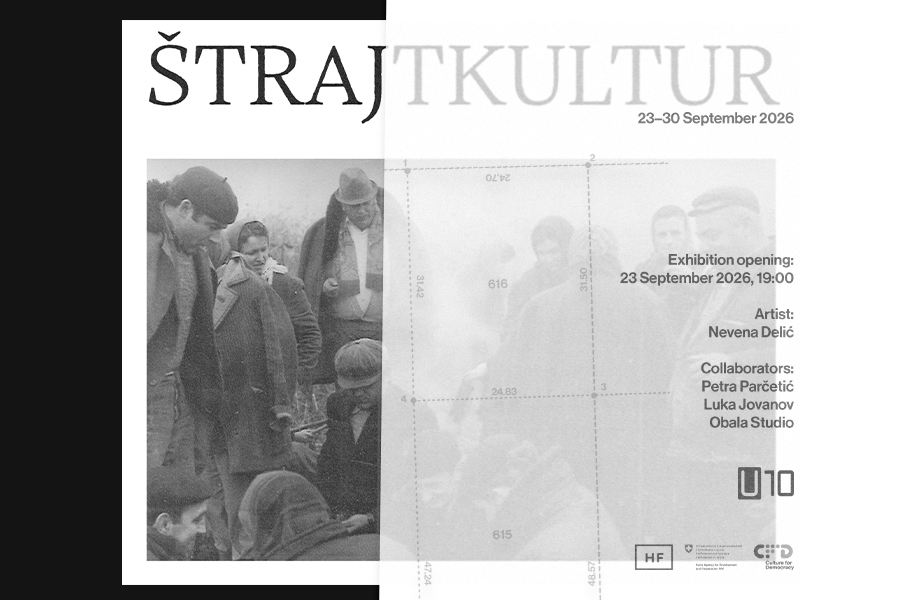
The exhibition deals with land as a mediator, witness, and agent from a translocal and transhistorical perspective. It looks into how land and property relations shape family histories, memory, human relations, and political imaginaries. The question of how we understand land—a contested notion inherently tied to resources, property regimes, and different emancipatory struggles—is the focus of Nevena Delić’s ongoing research.
This project explores relationships to land, the logic of (non)ownership, and land as a surface of projection and identification in two directions, looking back to the past through land deeds, found and reappropriated material, and family archives, while simultaneously speculating about possible futures and rooting political imagination in emerging land relations. The central part of the exhibition consists of a board game titled “Štrajtkultur”. The game mediates notions of commons, relationality, conflict, and radical democracy, imagining what structures are needed for antagonism to become a creative force, and asking if such instances of playful interaction can serve as an exercise of political imagination.
Radical democracy, according to Chantal Mouffe, is a democracy that does not seek to eliminate antagonism, but rather relies on it and recognises it as a necessity of a democratic system. As the basic principle of the board game, antagonism is articulated differently each time the game is played. The game is an invitation to look at abstract political theory and imagine what it would mean on an everyday level. In this case, it is the idea of conflict as a constituent part of existing in the world, and of exercising it as an everyday experience. The game poses the questions: How can this antagonism become a creative force? Would our democratic systems be different if we had a different relationship to land, one not based on ownership and extraction, but rather relationality and codependency? The table serves as material infrastructure for social life, sustaining and mediating human relationships, and it is the shape that the installation takes. Thinking through Hannah Arentd’s understanding of the public, and the social, where the table serves as a recurring metaphor, it can be seen as a coming together, something that both gathers and separates us, a place of negotiation, of hospitality, of care. “Štrajtkultur” alludes to the antagonistic character of the game, of land struggles, and family disputes over land. In German, it means “culture of debate”, which is transcribed and literalized to mean “the culture of dispute”, further connecting it to the agonistic understanding of how we inhabit the world.
Bringing together different media and approaches with an accompanying program, the exhibition functions as a space of gathering and exchange. During the opening event, a publication developed together with Stefan Jovanović / Obala Studio will be presented. The discursive program, developed as a collaboration with Petra Parčetić and Luka Jovanov, further explores translocal, transgenerational and historical perspectives on land.
Petra Parčetić will lead a workshop focused on identifying the role of land in mapping the ways political, societal and economic circumstances influence family histories and relations. The participants are invited to bring an object that reflects personal and family histories dictated or mediated by land. These objects become the point of departure for further discussions and mutual exchanges of experiences and perspectives on family feuds, relation-building and power structures present within families.
Luka Jovanov presents “The Line”, a participatory performance in which a spatial, and consequently social, system is gradually established in front of the audience. Departing from the simple need for a line to be spoken, transmitted, and shared, the performance develops as a sequence of rules, roles, proposals, rights, and procedures, with each new rule emerging as a response to a problem produced by the previous one: in an attempt to protect the participants, distribute responsibility, and enable their freedom, the system becomes increasingly complex and increasingly (in)capable of organising that freedom. The performance is shaped by already existing texts, proposals assigned in advance, and participation in decision-making in accordance with existing rules. Participation gradually turns into representation, and representation into administration, leading to a central question: how does a procedure intended to enable collective action begin to replace that very collective action?
The line emerges as a consequence of joint engagement: as a line of speech, a line of division (both spatial and conceptual), a line that defines belonging and/or a line of inherited responsibility. The performance thus explores how systems produce consensus, how they appropriate resistance, and how, under the guise of protection and democratic participation, they preemptively divide and separate people, spaces, and, more broadly, attempts at free action.
Dramaturg: Bojan Jablanovec; Producer: Špela Trošt; Production: Via Negativa
Program schedule:
23 September at 19:00 – Opening & publication presentation
26 September at 12:00 – Workshop, Petra Parčetić (duration 90 minutes)
26 September at 17:00 – Štrajtkultur, board game activation & discussion (duration 90 minutes)
29 September at 18:00 – Performance “The Line”, Luka Jovanov (duration 60 minutes)
…
The exhibition and program are supported through the Culture for Democracy project of the Heartefact Foundation.
