
Tangenta
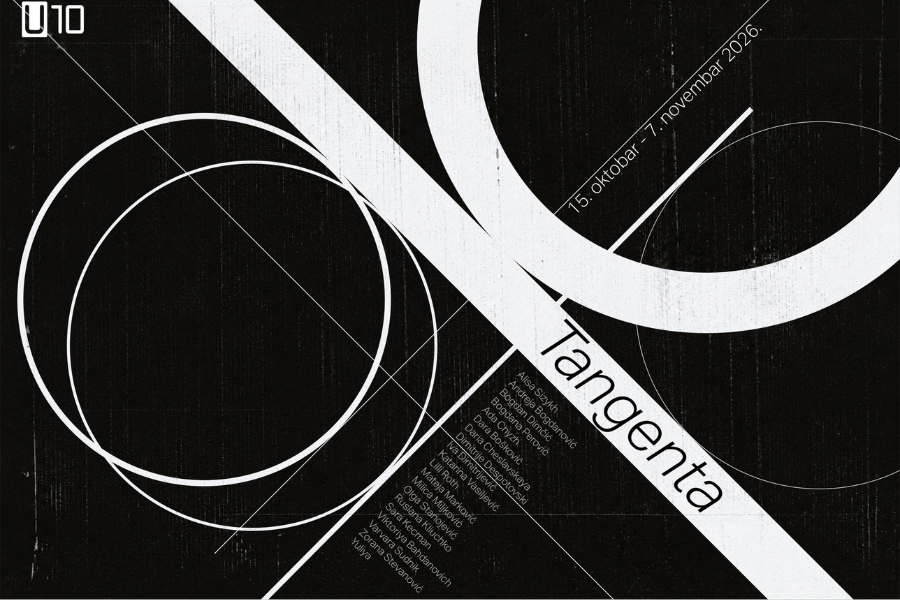
The group exhibition Tangenta presents works by young artists from Germany, Belarus, Serbia and Ukraine, created during four editions of the Art Camp Tangente organized by the cultural association Herbsthausen from Gartow and the non-profit organization JANUN from Hanover. Over the years, the camps have been shaped by different thematic frameworks, yet they have repeatedly raised questions concerning the relationship between the individual and the community, freedom, belonging, borders, memory and responsibility.
The process of creating the exhibited works has been shaped by diverse lived experiences and political realities marked by the post-pandemic condition, migration, war and repression. The exhibition Tangenta seeks to bring these experiences together through a deeper reflection on what it means to belong, to search and to define oneself in the contemporary world, translating them visually into a new context.
Approaching different points and touching upon them without equating them, Tangenta does not establish a single narrative that would connect all the works on display. On the contrary, the differences between the artistic positions remain important. The four countries from which the artists come have different histories, political systems and social realities, and similar questions therefore emerge in their work in different forms and with varying degrees of intensity, within different contexts and at different moments in time. Some of these contexts are explicitly political, while others appear through subtler traces, expressed in relation to language, the body, memory, space, material, or everyday life. What connects them is not necessarily a shared experience, but rather the fact that different experiences have been reflected upon and articulated within the same space, forming an almost invisible continuity.
The exhibition Tangenta is conceived as a dynamic dialogue between different media, creating a fragmented yet interconnected narrative. The works, shaped by conflict, displacement and the struggle for self-determination, reflect the tensions and constraints of the societies from which they emerge, while personal stories intersect with broader global questions. Despite their different cultural backgrounds, there is a shared sense of searching, questioning and redefining. In this way, Tangenta reveals the layered nature of the artistic positions of young people whose voices are shaped in the shadows of political borders, but also in the light of collective creation.
An important layer of the exhibition lies in the fact that some of the works, due to their political, social or personal contexts, are difficult to exhibit in all the environments in which they might be relevant. The very (im)possibility of exhibiting them therefore becomes part of a broader question of how art moves between different political and social spaces, what it means to create and exhibit under different circumstances and how institutions and art spaces can make room for voices that are restricted or suppressed in their own environments.
Andreja Bogdanović
Katarina Vasiljević
